Founding batch ships Fall 2026. Waitlist members get early-bird pricing
Canary

Know what you are
actually breathing.

Canary is a pocketable environmental monitor with an e‑paper display. Seven sensors, a full day of history on screen, and nothing to subscribe to.

Three Canary monitors on a wooden desk, each showing a different e-paper readout: particulate matter, carbon dioxide and ambient pressure, plotted over the last day.
  • PM1.0Smoke
  • PM2.5Fine dust
  • PM10Pollen
  • CO2Stale air
  • UV‑B240–320 nm
  • °C / °FTemperature
  • %RHHumidity
  • kPa / inHgPressure
Carbon dioxide

The stuffiness you cannot smell.

You breathe it out, and behind a shut door it has nowhere to go. Outdoor air sits near 420 ppm; a closed bedroom or a full meeting room passes 1,000 ppm easily, which is roughly where people start reporting stuffiness and poor concentration. There is nothing to smell. Canary shows the climb, and how fast an open door undoes it.

Particulate matter

Smoke and dust too small to see.

Particles smaller than 2.5 micrometres reach deep into the lungs: wildfire smoke, pollen, road dust. The World Health Organization’s guideline is 15 µg/m³, and frying a steak can take a kitchen past it. What matters is the recovery: a spike that clears in twenty minutes means your extractor works; three hours means it does not.

Relative humidity

Too dry, too damp, and the narrow band between.

Below about 30% and skin, sinuses and wooden instruments all start to complain. Above 60% and you are inviting mould and dust mites. Canary shows which way your rooms drift over a day, and how far.

Temperature

Your thermostat is measuring the hallway.

One number for a whole home hides a lot: a nursery on an outside wall, a top‑floor bedroom in August. Sleep researchers tend to point at 16 to 19 °C (61 to 66 °F) for a bedroom, cooler than most people keep them. Canary reads the room it is actually in, and keeps the overnight curve.

Ambient pressure

Weather you feel before you see it.

Barometric pressure falls ahead of a weather front, often a day before the rain arrives. Plenty of people with migraines or aching joints say they can tell; what they have never been able to do is check. Canary keeps the curve, so a suspicion becomes something you can point at.

Ultraviolet

Sunburn has little to do with brightness.

UV‑B is the narrow band, 240 to 320 nm, that burns skin and drives vitamin D. It has little to do with how bright a day looks: a cool overcast afternoon can carry most of the ultraviolet of a clear one, and a sunny window blocks nearly all of it. Canary reads that band itself.

More than a monitor.

Most air quality gadgets give you one number and a coloured ring. Canary gives you the shape of your whole day.

A hand holding a Canary monitor, roughly the size of a deck of cards, showing 503 ppm carbon dioxide and a 24-hour graph.

An e‑paper display that never asks for your attention.

No glare, no backlight glow at 3am, no notification badge. The screen holds its last reading even between refreshes, and it stays legible in direct sunlight.

  • 24 hours on screen

    Every sensor plots its own history, so you see the spike and what caused it, not just the number right now.

  • Logs to a microSD card

    Years of readings written locally. Pull the card, open the file. Nothing is held hostage behind an account.

  • No subscription, no cloud requirement

    Canary works fully offline. If you want remote dashboards and alerts, host the server yourself or use our free cloud option.

  • Yours to reconfigure

    Build your own screen layouts, choose which readings sit where, and set the units for each reading independently: temperature in °C or °F, pressure in hPa, kPa, inHg or mmHg, particles by mass or count.

Every reading, plotted.

Sensor modules sourced from Switzerland, Germany and Korea. Each one draws its own 24‑hour trace on the e‑paper screen. Why these measurements matter.

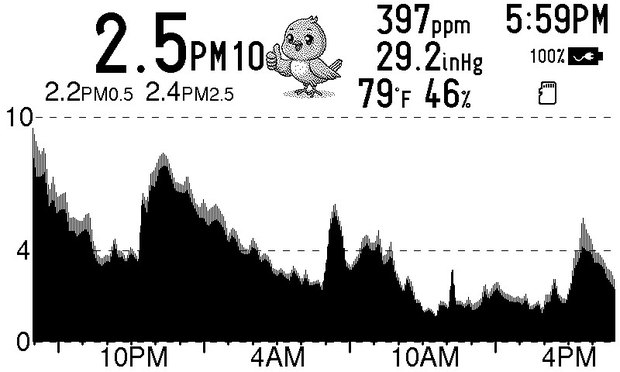
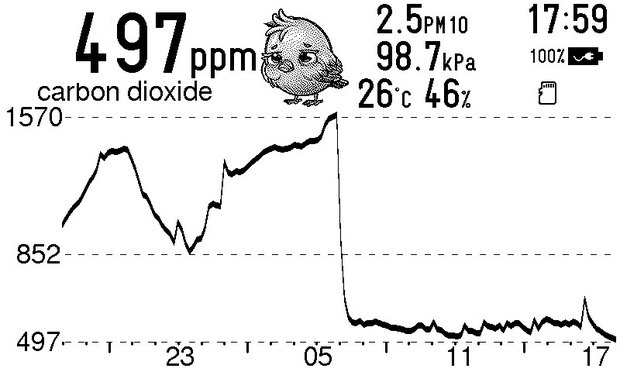
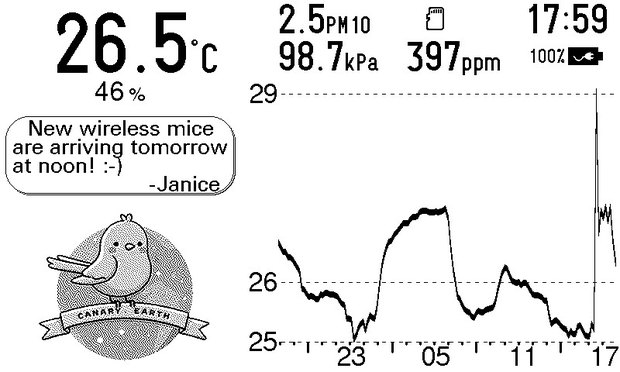
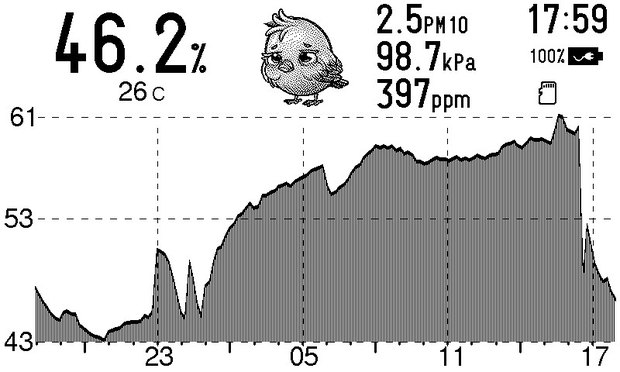
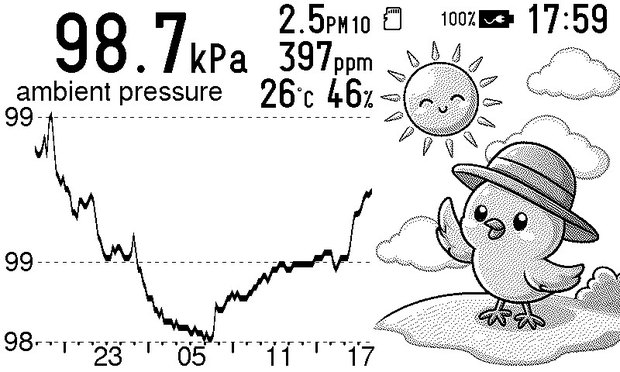
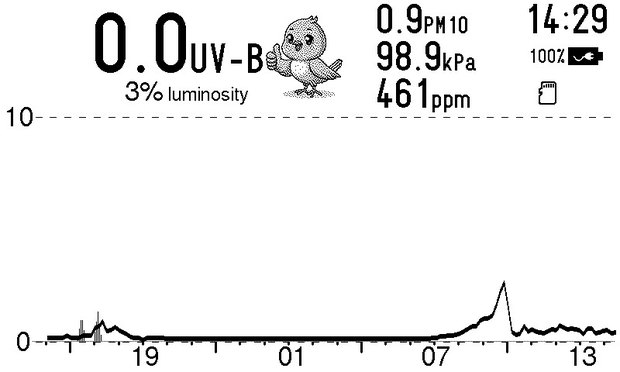
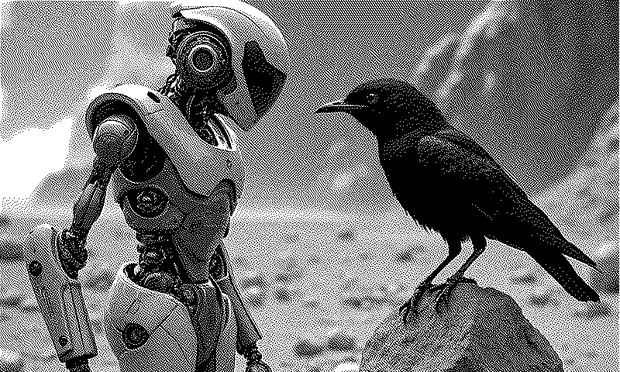
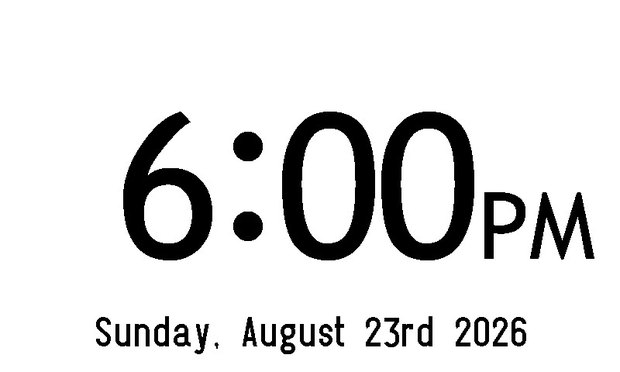
Canary showing 2.5 PM10 with a day of particulate history, the fill shaded by particle size band. Canary showing 497 ppm carbon dioxide, the overnight curve climbing then dropping sharply at 05:00. Canary showing 26.5°C beside a pinned note about wireless mice arriving tomorrow. Canary showing 46.2% relative humidity with the day’s curve rising from 43 to 61. Canary showing 98.7 kPa ambient pressure with a fair-weather illustration of the Canary bird. Canary showing 0.0 UV-B and 3% luminosity, with the light curve rising through the morning. Canary displaying a dithered black and white photograph of a bird beside a robot. Canary showing 6:00 PM and the date, Sunday August 23rd 2026.
Particulate matter

It counts particles by size.

A dual‑laser sensor sorts what it finds into size bands, PM1.0 through PM2.5 to PM10. Those bands are the greys in the trace, so the screen shows not just how much is in the air but how big it is. That is what separates kitchen grease from road dust from smoke drifting in off a fire.

Carbon dioxide

Sensitive enough to count the room.

A Swiss laser‑based CO2 sensor, accurate enough that you can see how many people walked in. On this trace the line climbs all night behind a closed door and falls off a cliff the moment it opens.

Temperature

The screen is yours to arrange.

Readings do not have to fill the whole display. This one gives up part of the screen to a note pinned beside the curve, which is the sort of thing e‑paper is good for: it costs nothing to leave sitting there for a week.

Relative humidity

Reading the room, not the board.

Humidity is easy to get wrong, because electronics make their own heat and dry the air immediately around them. This sensor sits vented and set apart from the warm side of the board. The curve here runs from 43 to 61% across a single day.

Ambient pressure

A full day of barometer.

Most barometers give you a number and a weather symbol. This one plots the whole day, so you see the slope rather than a snapshot, with an illustration that follows the trend and the reading in kilopascals, hectpascals or millibars.

Ultraviolet & light

Sunlight, measured twice.

A true UV‑B sensor, reading the 240–320 nm band directly rather than estimating it from visible light the way most consumer sensors do. Luminosity shares the screen, so you can tell if your office suspiciously illuminates in the dead of night while you're not there.

Photo viewer

A picture frame when you want one.

Take a photo in the app and it lands on your own Canary. Or on one you gave to somebody else, sitting on a shelf across the country. Everything is dithered down to one bit, which is the newsprint look e‑paper does better than any backlit screen in the house.

Clock

And the rest of the time, it is a clock.

Nothing to unlock, nothing to swipe away. When you are not asking it anything, Canary is a quiet desk clock that happens to be logging every reading in the background.

A Canary in a white case on a wooden table, showing a long overnight particulate hump.

At home

The overnight hump nobody knew about.

A Canary on a desk next to an air purifier, its particulate trace climbing steeply overnight to 70.9 PM10.

Beside the purifier

It tells you when to switch the thing on.

A Canary held in one hand beside a keyboard, showing a carbon dioxide reading.

In hand

Pocketable. Readable in full sun.

A Canary held up against trees and blue sky in Tricorder mode, showing 4.74 PM10 with max, average and minimum.

Out on a walk

Tricorder mode, held up to the sky.

A Canary standing at the edge of a chessboard mid-game, showing 846 ppm carbon dioxide.

At the table

Silent. No fan, no chime, no glow.

A Canary on a reflective gold surface showing 585 ppm carbon dioxide and the night's full curve.

On the desk

A whole working day, at a glance.

A Canary on a windowsill above a snowy street, showing ambient pressure dropping steeply.

On the windowsill

Watching the pressure fall ahead of the snow.

Three Canary units on a table all showing an uploaded Happy Mother's Day photo, with the upload tool open on the monitor behind them.

Given away

Send a picture to a Canary across the country.

A Canary displaying the words Ready, Place mask over holes, with a line drawing of a respirator mask.

Mask test

Find out what your respirator really filters.

A Canary laid out in parts on a wooden bench: the assembled unit, a spare e-paper panel, battery, antenna, USB-C board, sensor module, speaker and ribbon cables.

Built to be opened.

Every part you can see here is a part you can replace. The battery, the e‑paper panel, the sensor module, the USB‑C board: all of it comes apart with ordinary tools and goes back together again.

We would rather sell you one Canary that lasts a decade than five that do not. Right to repair is a design constraint here: no glue where a screw would do, no pairing locks, no parts you have to ask our permission to buy.

Five years of getting here.

The first one was a hospital CO2 sensor taped to a PC. The second lived in half a toothpaste box. Nine prototypes later, this is the one you can buy.

Read the development history

Specifications

The numbers.

Seven sensor modules, one e‑paper screen, and a battery that charges over the same USB‑C cable as everything else you own.

  • UV‑B and light sensors
  • microSD card
  • USB‑C port
  • Touch button
  • E‑paper screen
  • Air inlet and outlet
  • Reset button

Display

Type
E‑paper, monochrome
Diagonal
4.26″
Resolution
800 × 480
Backlight
None
Refresh
1.5 s full refresh

Power

Battery
2000 mAh Li‑po
Charging
USB‑C
Reported telemetry
Voltage, charge state
Battery life
21 days typical
Charge time
3 h

Connectivity & storage

Wireless
Wi‑Fi, Bluetooth
Mesh
ESPNow®, Matter over Wi-Fi
Wired
USB‑C
Logging
microSD card
Server
Self‑hosted, optional
Wi-Fi standard
2.4 GHz Wi-Fi 4 (IEEE 802.11 b/g/n)
microSD capacity
up to 32 GB for approx. 5,830 years of logs
Mesh range
30m to 100m indoor; 400m to 1km line of sight

Physical

Dimensions
110 × 67 × 18 mm
Weight
118 g
Enclosure
Soft-touch, user-openable
Operating range
0 to 50 °C (32 to 122 °F)

Alerts

Notification light
RGB, diffused through the top of the enclosure
Sound
Buzzer, customisable melody
Silent mode
Light only, no sound

Particulates

Mass concentration
PM1.0 · PM2.5 · PM4.0 · PM10
Number concentration
PM0.5 · PM1.0 · PM2.5 · PM4.0 · PM10
Typical particle size
Reported
Method
Dual‑laser scattering
Range
0 to 1000 µg/m³
Accuracy
±10 %

Air & climate

Carbon dioxide
ppm, NDIR
Temperature
°C / °F
Relative humidity
%RH
Barometric pressure
hPa / kPa / inHg / mmHg
CO2 range
0 to 5,000 ppm
CO2 accuracy
±3 %
Temp accuracy
±0.8 °C (±1.4 °F)
RH accuracy
±6 %RH

Light

Ultraviolet
UV‑B, 240–320 nm
Ambient light
Luminosity 0% to 100%

On screen

History
24 h per reading
Layouts
User configurable
Units
Set per reading
We do a lot of in-person wellness workshops, and people notice it sitting on the table. It's a nice subtle way to show guests we're paying attention to the environment.
Triana ShawCEO, The Atlas Connective
I was pretty skeptical at first. But after seeing the real-time data during wildfire season, we bought an air purifier for the main office.
Mikhail PivovarCEO, Routey OS
Pack twenty people into a workshop room for four hours and the air gets heavy fast. The graph on screen makes it obvious when we need to pause for a stretch break and open the windows.
Nicole Cummings-MorganFounder, W1derus Educational Workshops Inc.
My lab gets pretty warm with all the hardware and server gear running constantly. Canary sits right next to my dev rig so I can track temperature spikes and it even showed me when a power supply was smoking.
Reza GhochkhaniFounder, HADHOX
Developing global hardware partnerships requires endless travel and long boardroom hours; Canary keeps my immediate breathing space healthy wherever I land.
Konstantin BenkovskiyCEO, BenKo
Canary is a game-changer for executive health, keeping my air clean and my focus sharp during long investment strategy sessions at the office.
Avital AronovFounder, Prime AI Growth Office

Canary for organizations

One room, or two hundred.

Offices, schools and facilities run Canary on its own mesh, on their WiFi, or through canary.earth with every site on one dashboard.

  • Mesh networking

    Units relay for each other across floors and outbuildings where WiFi does not reach.

  • HVAC that answers to evidence

    Find the meeting room that never clears, the wing the air handler forgot, the hour your filters stop coping.

  • Campus-wide smoke alerting

    When wildfire smoke reaches the property line, every unit knows, and so does whoever decides about outdoor break.

Talk to us about a deployment

A Canary standing on a classroom desk beside an apple, a stack of books and a pot of pencils. The blackboard behind it is chalked with vape detection, HVAC optimization and low CO2 for learning, and the screen reads Coming soon.

First units, first price.

The founding batch is small and hand-checked. Waitlist members get early-bird pricing and the first shipping slots.

Canary – founding batch Ships Fall 2026
$249 $299 Waitlist price
  • Canary monitor with soft-touch enclosure, USB‑C cable, USB‑C charger and microSD card
  • All seven sensors: nothing behind a paywall or a firmware tier
  • Replacement parts and instructions available from day one
  • Self-hosted server software or an account on our website, free and unlimited
Join the waitlist for this price

Joining the waitlist does not charge you anything and does not commit you to buying.

Be first in line.

Leave your email and we will tell you once: when the founding batch opens, with your early-bird price attached. That is the entire mailing list.

One email at launch. No newsletter, no partners, no resale. Unsubscribe is a link in the same email.

Tell us what you would like

Every question is optional. Answer as many as you like, in as much detail as you wish.

Which language do you prefer for the settings menu?

Font size, screen layout, Wi‑Fi login and the clock are some of the options you may wish to set once.

Which accessories would you like?

Choose any.

How would you like to reach the options menu?

Canary is completely independent and does not need internet access. An app or a browser can still make the options easier and add advanced graphing. Choose any.

Do you want to connect Canary to a home assistant?

Choose any.

How many Canaries are you interested in buying?

We don’t want to use AI for any of the artwork or commercials. Do you know a wonderful illustrator, a passionate photographer or a clever web designer who might like to join us?

Questions, answered.

What does Canary measure?

Fine particulate matter (PM2.5, and coarser and finer fractions), carbon dioxide, UV‑B, temperature, relative humidity and ambient pressure. Particulates are the tiny airborne particles produced by wildfire smoke, traffic, wood burning and cooking, and they are one of the most important indicators of air quality.

Can I change the units?

Yes, and each reading has its own setting, so you can mix them: temperature in °F alongside pressure in hPa, for instance. Temperature shows in °C or °F, pressure in hPa, kPa, inHg or mmHg, and particles either by mass (µg/m³) or as a particle count (#/cm³).

Why does PM2.5 matter?

PM2.5 particles are roughly 30 times smaller than the width of a human hair. Because they are so small they can be inhaled deep into the lungs, and may affect everyone, especially children, older adults, and people with asthma or other respiratory conditions.

Can Canary detect wildfire smoke?

Yes. Wildfire smoke is largely made up of fine particulate matter, which is exactly what Canary is built to monitor. During wildfire season it helps you understand how much smoke is making its way indoors, so you can act when it does.

Why monitor indoor air when I can check the forecast?

Most people spend around 90% of their time indoors, and outdoor air quality reports cannot tell you what is happening inside your home. Indoor air varies enormously with ventilation, filtration, cooking, candles, fireplaces, and whether smoke is getting into the building.

Is it suitable for a nursery?

Yes, and it is one of the most common places people put one. There is no backlight and no sound by default, so it will not disturb a sleeping child while it tracks the room overnight.

Does Canary clean the air?

No. Canary measures air quality; it does not filter it. Think of it as the information that tells you when to run the purifier, open a window, or change an HVAC filter. And, just as usefully, when you do not need to.

How accurate is it?

Canary uses high-quality sensor modules built for continuous monitoring. No consumer monitor is intended to replace laboratory equipment, and we will not claim otherwise. But Canary gives reliable, consistent measurements that let you track how your air changes over time, which is what actually drives decisions.

Where should I put it?

In the room where you spend the most time: a living room, bedroom or nursery. Avoid placing it right beside a window, a vent, the stove or a humidifier, since those will skew the readings locally rather than tell you about the room.

Will cooking set it off?

It will show it, and that is the point. Frying, grilling and high-heat cooking produce a lot of PM2.5. Most people are genuinely surprised to find that making dinner can briefly push indoor particle levels past what is outside during a pollution event.

Is this only useful during wildfire season?

Plenty of people wish to buy one because of smoke and then keep using it year-round. Indoor air shifts constantly with cooking, wood-burning stoves, seasonal allergens, renovations, and how tightly the house is shut against the weather.

Do I need to be technical to use it?

No. Out of the box you place it somewhere and read the screen. The mesh networking, self-hosted server and custom screen layouts are there if you want them, and entirely ignorable if you do not.

What happens when I join the waitlist?

We store your email address and use it once, to tell you the founding batch is open, with your early-bird price. No newsletter, no sharing with anyone else, and an unsubscribe link in the same email. Joining costs nothing and commits you to nothing.